

AiM Medical Robotics Awarded $2 Million National Cancer Institute Grant to Advance MRI-Guided Robotic Treatment of Brain Cancer
$2.1M NIH SBIR Phase II grant supports development of AiM’s MRI-compatible neurosurgical robotic platform for precision delivery of ablative brain cancer therapies
WORCESTER, Mass., Sept. 02, 2026 (GLOBE NEWSWIRE) -- AiM Medical Robotics, a leading developer of advanced robotic systems for MRI-guided neurosurgery, today announced that it has been selected to receive $2 million Phase II Small Business Innovation Research (SBIR) award from the National Cancer Institute (NCI), part of the National Institutes of Health (NIH), to advance the use of its robotic platform for MRI-guided ablative treatment of brain cancer. The SBIR program, often referred to as "America’s Seed Fund," is a highly competitive federal program that supports scientific excellence and technological innovation through the investment of federal research funds in critical American priorities.
The award, entitled “Intraoperative MRI-Guided Neurosurgery Robot for Enhancing Ablative Treatment of Brain Cancer,” will support further development and clinical evaluation of AiM’s technology for precise robotic intervention within the MRI environment. This effort will support enhanced tumor ablation planning and treatment delivery with real-time MRI-based thermometry that is tightly coupled to robot control in order to optimize eradication of tumors while minimizing collateral damage. The project is led by AiM founder Gregory Fischer, PhD, who is the Principal Investigator and is in partnership with the National Center for Image-Guided Therapy (NCIGT) at Brigham and Women’s Hospital (BWH) and Co-investigators Nobuhiko Hata, PhD and G. Rees Cosgrove, MD.
“Brain tumors remain a major clinical challenge, and MRI-guided laser interstitial thermal therapy (LITT) is limited by the accuracy of probe placement, intraoperative visualization, and procedural complexity. The outcomes of this research could significantly improve the precision, safety, and efficiency of minimally invasive thermal ablation of intracranial tumors.” said Dr. Hata, “The National Center for Image Guided Therapy and its AMIGO operating rooms provide the unique translational environment needed to evaluate these advances directly within real MRI-guided neurosurgical workflows.”
AiM is developing a neurosurgical robotic platform designed to enable procedures to be performed under direct MRI guidance. Unlike conventional approaches that may require patients to be moved between imaging and treatment environments, AiM’s technology is being developed to allow robotic intervention within the MRI suite, providing the potential for physicians to use high-quality imaging during the procedure to plan, guide and assess treatment.
This NCI-funded program will investigate application of the technology to ablative treatment of brain cancer, extending AiM’s platform beyond functional neurosurgery and demonstrating its potential applicability across a broader range of intracranial procedures.
“We are incredibly honored to receive this validation and support from the NCI. Receiving this award is significant well beyond the funding; it validates the clinical and business need through a highly rigorous peer review process and it enables us to demonstrate this technology in brain cancer therapy.” said Dr. Fischer, “Our vision has always extended well beyond any single procedure. We are building a platform intended to enable physicians to precisely, reliably, and safely reach targets within the brain and perform interventions while benefiting from the extraordinary imaging capabilities of intraoperative MRI. Brain cancer is an area where accuracy matters enormously, and this NCI-supported program provides an opportunity to demonstrate how our technology might ultimately contribute to more precise, image-guided treatment.”
The award supports a first-in-human feasibility study in the Advanced Multimodality Image-Guided Operating (AMIGO) suite at BWH and covers a project period extending from September 2026 through August 2028. The award provides for an anticipated $2,017,320 in federal funding over two years, with $1,008,660 funded for Year 1 and the balance subject to availability of funds and satisfactory project progress.
Julie Pilitsis, MD, PhD, MBA co-Founder of AiM Medical Robotics and Chair of the Department of Neurosurgery at University of Arizona College of Medicine - Tucson, said: “Successful treatment of intracranial disease depends upon knowing precisely where you are, reaching the intended target safely and confirming what has been accomplished. MRI provides remarkable anatomical information, but historically the engineering challenge has been bringing sophisticated robotic intervention into that environment. Combining these capabilities has the potential to create an entirely new way of approaching precision neurosurgery.”
The award comes as AiM continues to advance its MRI-compatible robotic platform through clinical development. The company believes the same fundamental ability to precisely navigate and intervene within the brain under MRI guidance could ultimately support multiple applications, potentially including functional neurosurgery, biopsy, ablation and targeted delivery of therapeutics.
For brain tumors in particular, the ability to combine precise robotic positioning with intraoperative MRI could offer an important advantage. Brain anatomy can change during procedures, while the relationship between a planned trajectory and the actual treatment target can be critical to therapeutic success. Further, with tumor ablation, real time monitoring of thermal dose during delivery, and adapting as needed, is essential to ensuring complete tumor ablation with minimized damage to surrounding sensitive tissue. Performing intervention and imaging within the same environment creates the potential to verify targeting and treatment without relying exclusively upon preoperative imaging.
Dr. Fischer further said: “For many years our engineering objective has been to overcome one of the fundamental limitations in image-guided intervention: the difficulty of combining highly precise robotics with the MRI environment. This NCI award builds upon prior NIH-supported development led by AiM co-founders Drs. Pilitsis and Fischer, and allows us to apply that work to one of the most challenging problems in neurosurgery. It is an important validation of the technology, the clinical need, and the business case and, provides our team the resources through substantial non-dilutive capital to continue translating it toward clinical use.”
About AiM Medical Robotics
AiM Medical Robotics is a privately held medical device company based in Worcester, MA, developing the next-generation dynamic image-guided neurosurgery system. AiM’s MRI-guided robotic surgery system enables highly precise and efficient image-guided neurosurgical interventions. AiM's compact and portable MRI-compatible robotic surgery platform integrates actuated instrument alignment into existing clinical workflows while enabling continuous, real-time visualization during surgery. By integrating robotics directly within the MRI environment, AiM aims to reduce procedural variability, improve safety, reduce procedure time, and expand access to advanced neurosurgical care. The company is focused on scalable platform development with clear regulatory and commercial pathways. Looking ahead, AiM plans to harness the power of artificial intelligence to enhance its robotic platform, creating an intelligent surgical ecosystem that can learn from real-world data, optimize workflows, and provide surgeons with predictive insights in real time. By combining advanced intelligent robotics with intraoperative imaging, AiM seeks to unlock a new era of accessible, faster, safer, and more precise brain surgery.
To learn more about AiM Medical Robotics and its neurosurgical robotics platform, visit https://www.aimmedicalrobotics.com/ and follow the company on LinkedIn at http://www.linkedin.com/company/aim-medical-robotics.
Forward-Looking Statement
This press release includes forward-looking statements within the meaning of the Private Securities Litigation Reform Act of 1995 and other federal securities laws. These statements are based on AiM's current expectations, estimates, and projections about our industry, our business, and the device we are developing, and are subject to substantial risks, uncertainties, and assumptions. The statements concern AiM's business strategies; research and development plans; the timing of regulatory submissions; the ability to obtain and maintain regulatory authorizations of AiM's products; market acceptance of AiM's products; AiM's intellectual property; AiM's reliance on third-party organizations; AiM's competitive position; AiM's industry environment; AiM's anticipated financial and operating results, including anticipated sources of revenue; AiM's assumptions regarding the size of the available market and the benefits of AiM's products; product pricing and timing of product launches; management's expectations with respect to future acquisitions; AiM's goals, intentions, plans, and expectations, including the introduction of new products and markets; and AiM's cash needs and financing plans.
Actual events may differ materially from the expectations indicated by such forward-looking statements. You should not place undue reliance on these forward-looking statements, which can be identified by words such as “could,” “believe,” “anticipate,” “intend,” “estimate,” “expect,” “may,” “will,” “continue,” “predict,” “potential,” “project,” or similar terms, variations of such terms, or the negative of those terms. AiM's medical device is currently in development and remains subject to significant risks and uncertainties, including, but not limited to, delays or difficulties in preclinical and clinical testing, obtaining required regulatory authorizations, supply chain and manufacturing challenges, changes in market conditions, and potential competition. The timing and outcome of regulatory reviews and clinical trial results are inherently uncertain and could adversely affect the commercial viability of AiM's products. AiM may not realize its expectations or achieve its plans, and actual results may differ materially from those indicated by these forward-looking statements as a result of various factors. All forward-looking statements reflect the current beliefs and assumptions of AiM management as of the date of this press release and should be regarded solely as AiM's current plans, estimates, and beliefs. AiM cannot guarantee future results, events, or performance. AiM does not undertake and specifically disclaims any obligation to update or revise any forward-looking statements to reflect new information, future events or circumstances, or the occurrence of unanticipated events, except as may be required by applicable law.
Media Contact: Gregory Fischer, Ph.D.
Founder & Chief Executive Officer
info@aimmedrobotics.com
617-203-5560
Investors: Investor Relations
IR@aimmedrobotics.com
NIH Funding Acknowledgment
Research reported in this press release is supported by the National Cancer Institute of the National Institutes of Health under Award Number R44CA314728. The content is solely the responsibility of the authors and does not necessarily represent the official views of the National Institutes of Health.
Attachments


Figure: 1
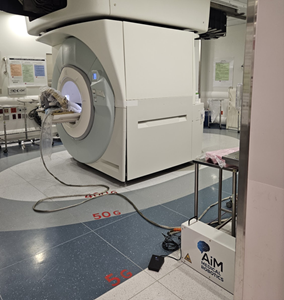
AiM’s stereotactic neurosurgery robot operating with an MRI scanner in the NCIGT’s AMIGO suite at Brigham and Women’s Hospital.
Figure: 2
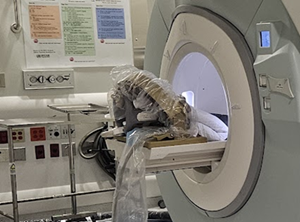
AiM’s compact actuated stereotactic frame is compatible with the MRI environment and operates within the bore of high field MRI scanner. It enables real-time monitoring of anatomic changes and thermal dose maps, which under this award, will be used to ensure precise ablation of brain tumors.
Figure: 3

Principal Investigator and Program Director Gregory Fischer, PhD, Co-founder of AiM Medical Robotics.
Legal Disclaimer:
EIN Presswire provides this news content "as is" without warranty of any kind. We do not accept any responsibility or liability for the accuracy, content, images, videos, licenses, completeness, legality, or reliability of the information contained in this article. If you have any complaints or copyright issues related to this article, kindly contact the author above.
