

New Analysis Examines Cost Factors in Lightning Risk Assessment Software Selection
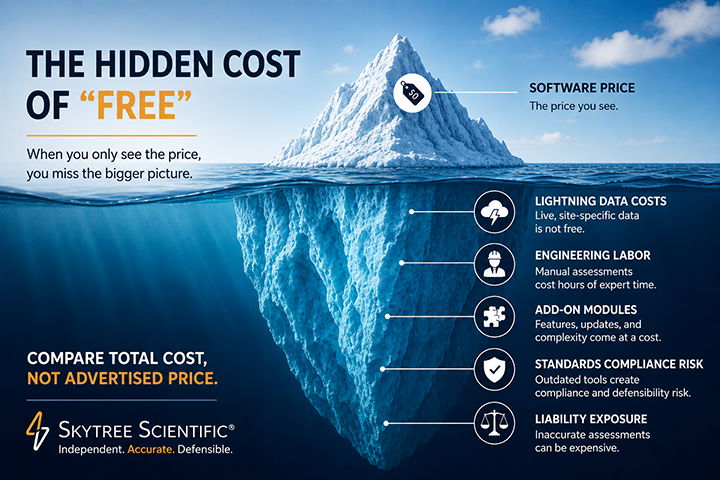
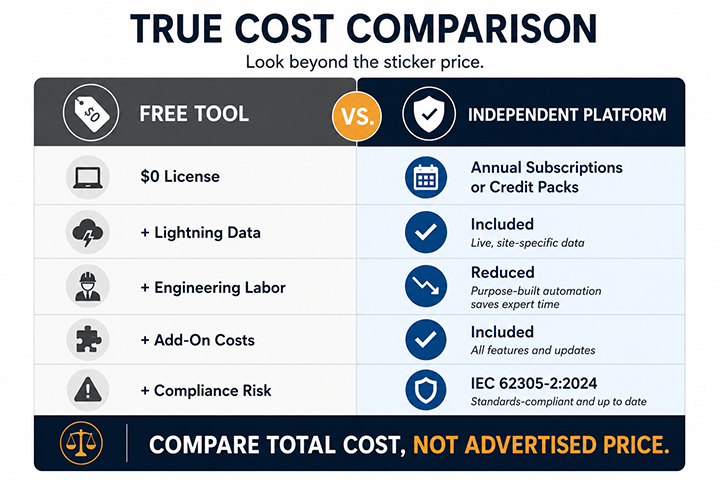
What do free lightning risk assessment tools really cost? Hidden data, labor, and compliance expenses can far outweigh the advertised price.
ASHEVILLE, NC, UNITED STATES, June 17, 2026 /EINPresswire.com/ -- When a tool is offered for free, it's worth asking a straightforward question: how is the company behind it making money?That question matters enormously in lightning protection - an industry where the quality and independence of a lightning risk assessment (LRA) can determine whether a facility is protected, insurable, or defensible in a legal proceeding. And yet, the conversation around assessment tools has long been dominated by advertised price tags that obscure what a professional is actually getting - and what they are not.
This is an examination of what "free" and "low-cost" lightning risk assessment tools truly cost, who benefits from offering them, and what the profession deserves instead.
The Economics of a Free Tool
No company builds, maintains, and distributes software out of goodwill. Every free tool has a business model behind it - and in lightning protection, that model is almost always hardware sales.
Many of the most widely used assessment tools are offered by the same companies that manufacture and sell lightning protection systems. For these vendors, the assessment software is not the product - it exists to guide users toward a purchasing decision that benefits the vendor.
The question isn't whether these tools can produce an output. They can. The question is whether that output is designed to be accurate above all else - or designed to support a sale.
The Three Hidden Costs No One Talks About
Beyond the conflict-of-interest problem, the advertised price of low-cost assessment tools routinely omits three categories of cost that add up quickly.
Lightning strike density data.
A credible lightning risk assessment under IEC 62305-2 requires accurate, location-specific lightning strike-point density data. This data - the industry standard - is not free. It is a commercial data product that can be very expensive when purchased separately. Tools that advertise a low annual price frequently do not include this data, leaving users to source it themselves, rely on static or outdated databases, or skip it entirely.
Engineering labor.
A lightning risk assessment performed without purpose-built software - using spreadsheets, manual calculation, or tools that require significant data entry and interpretation by the engineer - takes time. Industry estimates place the average manual LRA at 8+ hours of qualified engineering time. At $120 to $150 per hour, that's $720 to $1,200 per assessment in labor cost alone.
Add-ons, modules, and version limits.
Some tools advertise a base price covering only a limited feature set, requiring separate add-ons for complex geometry or current standards compliance. Others are buried inside expensive enterprise suites - or still ship on physical media with hardware dongles, technology that belongs to a different era.
The Standards Problem
Lightning risk assessment methodology has evolved. IEC 62305-2:2024 - the current edition of the international standard - introduced meaningful updates to how risk is calculated. A professional whose tool was last updated to the 2010 edition is not working to the current standard.
This matters for defensibility. Assessments used for insurance, permitting, or legal purposes need to demonstrate compliance with the current standard. Organizations using outdated tools carry that exposure regardless of what those tools cost.
What Independence Actually Means
An independent assessment is one where the software has no stake in the outcome. No hardware to sell. No system design to justify. The risk calculation is the calculation - not a prelude to a sales conversation.
This distinction has practical implications. When an assessment is used to support a building permit, satisfy an insurer, or defend against a liability claim, the methodology and the independence of the tool matter. An assessment prepared with a tool sold by a company that also profits from the protection system being recommended is, at minimum, a document that invites scrutiny. At worst, it is one that fails to withstand it.
The ROI Calculation That Changes the Conversation
When the full cost picture is assembled - live data acquisition, engineering labor, add-ons, and the risk exposure created by outdated standards or conflicted methodology - the economics of "free" tools shift substantially.
Consider a small lightning protection firm running eight assessments per year. On paper, a $0 software tool looks attractive. In practice, that same firm is spending roughly $5,760 annually in labor and data costs to produce those assessments manually, while carrying the compliance and liability exposure of a tool that lacks independent methodology.
An engineering team running 30 assessments per year faces more than $36,000 in combined labor and data costs under a manual or low-cost toolset. A large contractor managing 80 assessments is looking at well over $100,000 in true annual cost - before any discussion of what it costs if an assessment fails to hold up when challenged.
What the Industry Deserves
Lightning risk assessment is serious engineering work. The assessment underpinning any protection strategy should be prepared with tools built to get the answer right - not to close a deal.
The profession deserves tools that include live, site-specific data; platforms that stay current with evolving standards; AI-assisted scenario modeling; and professionally formatted, audit-defensible reports.
These are not premium features. They are the baseline of what a professional tool in this category should provide.
A Note on Transparency
Skytree Scientific developed LRAplus® as a purpose-built, independent lightning risk assessment platform. The company sells no hardware. It has no commercial stake in the outcome of any assessment performed on the platform. LRAplus® includes live, site-specific lightning strike-point density data automatically for every project, supports IEC 62305-2:2024 compliance, incorporates AI-powered scenario modeling, and produces audit-defensible professional reports in 57 languages - at a single, all-inclusive price.
Professionals who want to evaluate the platform can access a free 14-day trial at skytreescientific.ai with no credit card required.
About Skytree Scientific
Skytree Scientific is a software company dedicated to independent lightning risk assessment. Skytree sells no hardware and has no commercial affiliation with any lightning protection system manufacturer.
Kelly Buza
Skytree Scientific
+1 828-203-5175
email us here
Visit us on social media:
LinkedIn
YouTube
Legal Disclaimer:
EIN Presswire provides this news content "as is" without warranty of any kind. We do not accept any responsibility or liability for the accuracy, content, images, videos, licenses, completeness, legality, or reliability of the information contained in this article. If you have any complaints or copyright issues related to this article, kindly contact the author above.
