

Optical Sensor Market Forecast 2026–2036: Market to Reach USD 82.2 Billion at 8.3% CAGR
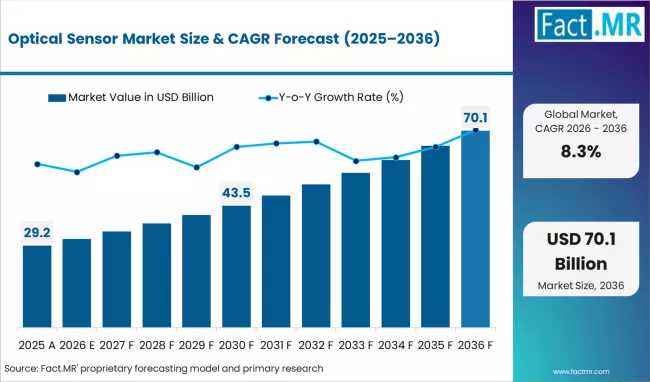
Optical Sensor Market
Optical Sensor Market is segmented by Type (Fiber Optics, Position Sensors, Image Sensors, Ambient Light Sensors, Proximity Sensors, Infrared Sensors)
ROCKVILLE, MD, UNITED STATES, March 18, 2026 /EINPresswire.com/ -- In the modern industrial economy, if data is the new oil, then sensors are the essential pipelines. What was once a niche component of high-end imaging is now the fundamental architecture of the "Age of Sensing." As industries transition toward total autonomy and hyper-connected ecosystems, the hardware that allows machines to "see" is witnessing a historic valuation surge.According to a comprehensive strategic analysis by Fact.MR, the global Optical Sensor Market—valued at USD 29.2 billion in 2025—is on a high-velocity trajectory. Demand is estimated to reach USD 31.6 billion in 2026 and scale to a staggering USD 82.2 billion by 2036. Expanding at a compound annual growth rate (CAGR) of 8.3%, the market is currently experiencing an absolute dollar growth of USD 50.6 billion over the next decade.
This expansion reflects a structural shift in global manufacturing. We are moving past incremental upgrades into a period of mass sensor deployment where non-contact detection and high-speed signal processing are no longer "premium" features but baseline requirements for electronics and industrial systems.
Get Access Report Sample :
https://www.factmr.com/connectus/sample?flag=S&rep_id=14579
The Silicon Sight: Drivers of the Optical Revolution
The demand for optical sensors is no longer confined to the photography lab. Today, it is anchored in the pocket of every consumer and the bumper of every new vehicle.
Key catalysts defining this transition include:
Smartphone Proliferation: Mobile devices now represent 35% of the market share. Manufacturers are integrating an increasing count of sensors per unit—including facial recognition modules, proximity sensors, and ambient light detectors—to enhance user interaction.
The Autonomous Vehicle Pivot: Advanced Driver Assistance Systems (ADAS) are increasingly reliant on high-performance image sensors for lane detection, object recognition, and parking assistance.
Industrial Machine Vision: As Industry 4.0 matures, factory automation equipment is adopting optical sensing for automated quality control, allowing for "zero-defect" manufacturing at speeds impossible for human inspectors.
Medical Monitoring: Optical sensing is becoming central to non-invasive medical devices, enabling real-time environmental detection and patient monitoring.
Emerging Trends: The Integration Frontier
A structural transition is currently occurring as conventional discrete optical sensors give way to integrated sensing modules. Industry leaders are no longer just selling a photodiode; they are selling a multifunction semiconductor platform. Advanced modules that combine infrared detection, image sensing, and environmental monitoring into a single chip are commanding higher unit prices and becoming the strategic choice for high-end smartphone and automotive brands.
Regional Insights: India and China Lead the Global Charge
While mature markets like the United States (9.3% CAGR) and Germany (8.7% CAGR) continue to lead in high-spec automotive and defense sensors, the epicenter of growth is shifting toward Asia’s semiconductor hubs.
India: Recording the fastest expansion with a 1% CAGR, supported by aggressive semiconductor manufacturing initiatives promoted by the Ministry of Electronics and Information Technology.
China: Projected to expand at a 8% CAGR, fueled by large-scale domestic semiconductor production and the sheer volume of its consumer electronics ecosystem.
Japan: Growing at 9%, Japan remains the global powerhouse for precision electronics and high-end imaging components.
Competitive Landscape: The Battle for Fabrication Dominance
The market is moderately concentrated, favoring firms with vertically integrated semiconductor fabrication capabilities. Competitive advantage is now defined by sensor accuracy, power efficiency, and the ability to operate reliably in the "harsh" environments of automotive engines and industrial plants.
Key industry participants currently shaping the landscape include:
Analog Devices, Inc., ABB Ltd., Hamamatsu Photonics K.K., STMicroelectronics N.V., Alphasense Ltd., Texas Instruments Incorporated, NXP Semiconductors N.V., ams-OSRAM AG, Honeywell International Inc., and ROHM Co., Ltd.
Analyst Insights: The Strategic Outlook
"Industry participants will observe that market expansion is now inextricably linked to semiconductor manufacturing capacity," says Shambhu Nath Jha, Principal Consultant at Fact.MR. "The companies that maintain advanced fabrication capabilities and invest heavily in photonics research are not just selling components—they are building the competitive moats that will define the next decade of industrial automation."
Conclusion: Future Opportunities in a Light-Driven Economy
As product cycles shorten and replacement demand accelerates, the optical sensor market represents one of the most resilient segments of the technology sector. The future lies in integrated sensor modules—combining imaging, proximity, and environmental sensing functions into a single, power-efficient package. For investors and executives, the path to value is clear: focus on the companies that are bridging the gap between photonics and multifunction semiconductor platforms.
Browse Full Report – https://www.factmr.com/report/optical-sensor-market
To View Related Report:
Optical Fiber-Embedded Textile Yarns Market https://www.factmr.com/report/optical-fiber-embedded-textile-yarns-market
Optical Switches Market https://www.factmr.com/report/1684/optical-switches-market
Optical Wireless Communication and Li-Fi Market https://www.factmr.com/report/3463/optical-wireless-communication-and-lifi-market
Optical Interconnect Market https://www.factmr.com/report/optical-interconnect-market
S. N. Jha
Fact.MR
+1 628-251-1583
email us here
Legal Disclaimer:
EIN Presswire provides this news content "as is" without warranty of any kind. We do not accept any responsibility or liability for the accuracy, content, images, videos, licenses, completeness, legality, or reliability of the information contained in this article. If you have any complaints or copyright issues related to this article, kindly contact the author above.
