

Electronic Medical Records Market to Reach US$31.55B by 2033 at 6.2% CAGR, North America Leads 42%
Electronic Medical Records Market
Electronic Medical Records Market to Reach US$31.55B by 2033 at 6.2% CAGR, Led by Epic Systems, Oracle; North America 42%
The electronic medical records market is expanding as healthcare providers adopt digital systems to improve data management and care coordination”
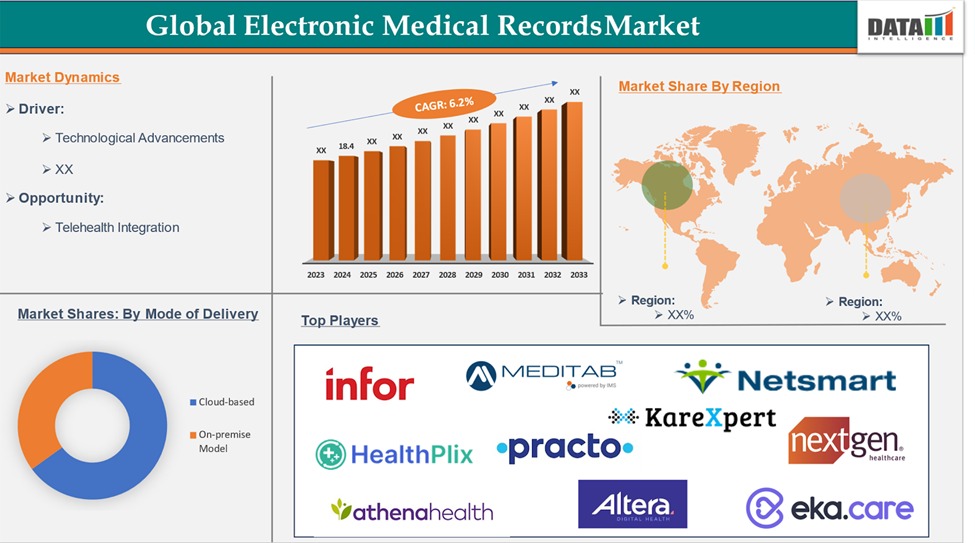
LEANDER, TX, UNITED STATES, December 18, 2025 /EINPresswire.com/ -- According to DataM Intelligence, the Global Electronic Medical Records Market reached US$ 18.4 billion in 2024 and is projected to grow to US$ 31.55 billion by 2033, expanding at a CAGR of 6.2% during the forecast period 2025–2033. Market growth is driven by the increasing digitalization of healthcare systems, rising demand for efficient clinical data management, and government initiatives promoting electronic health infrastructure to improve care quality and patient safety.— DataM Intelligence
Electronic medical records are digital versions of patient health records used by healthcare providers to store, access, and manage clinical information electronically. These records include medical history, diagnoses, treatment plans, medications, allergies, laboratory results, and immunization details. The adoption of electronic medical records enables real-time access to patient data, supporting faster and more accurate clinical decision-making while reducing medical errors and duplicate testing. Additionally, electronic medical records streamline administrative workflows such as billing, scheduling, and prescription management, helping healthcare organizations improve operational efficiency, reduce costs, and enhance coordination of care across providers.
Download your exclusive sample report today: (corporate email gets priority access): https://www.datamintelligence.com/download-sample/electronic-medical-records-market
Key Highlights from the Report:
The electronic medical records market is expanding steadily as healthcare providers adopt digital health systems to improve clinical workflows, patient data management, and care coordination.
Growth is driven by increasing demand for interoperability, regulatory initiatives supporting health IT adoption, and the need to reduce medical errors while enhancing care quality.
Cloud-based EMR solutions are gaining strong traction due to lower upfront costs, scalability, remote accessibility, and integration with telehealth and other digital health platforms.
Hospitals, clinics, and specialty practices are the primary adopters, leveraging EMR systems for patient charting, e-prescribing, billing integration, and analytics.
Market competition is shaped by continuous innovation, seamless EHR/EMR interoperability, mobile access, and data security/compliance features that support modern healthcare delivery needs.
Key Segments
By Type
Traditional EMRs hold a significant share as they remain widely used for digitizing patient records, clinical documentation, and administrative workflows across healthcare settings. Speech-enabled EMRs are growing rapidly, driven by increasing adoption of voice recognition technologies that reduce clinician documentation burden and improve workflow efficiency. Interoperable EMRs are witnessing strong expansion as healthcare systems prioritize seamless data exchange, care coordination, and compliance with interoperability standards. Other EMR types, including AI-assisted and mobile-based EMRs, continue to gain traction as providers seek enhanced usability and advanced clinical decision support.
By Mode of Delivery
Cloud-based models dominate the market due to their scalability, lower upfront infrastructure costs, remote accessibility, and ease of system updates. They support telehealth integration and multi-location healthcare operations. On-premise models maintain steady demand, particularly among large healthcare institutions that require greater data control, customization, and compliance with internal IT policies.
By End User
Healthcare providers represent a major end-user segment as physicians, clinics, and specialty practices rely on EMRs for patient management, billing, and clinical decision-making. Hospitals continue to drive strong adoption due to complex workflows, large patient volumes, and the need for integrated information systems. Patients are increasingly engaging with EMR platforms through patient portals that enable access to health records, appointment scheduling, and communication with providers. Other end users, including diagnostic centers and ambulatory care facilities, contribute to market growth as digital health adoption expands across the healthcare ecosystem.
Buy Now & Unlock 360° Market Intelligence: https://www.datamintelligence.com/buy-now-page?report=electronic-medical-records-market
Key Players
Altera Digital Health Inc. | athenahealth | EkaCare | HealthPlix | Oracle | Meditab | Practo Technologies Pvt. Ltd. | Medical Information Technology, Inc. (MEDITECH) | NXGN Management, LLC. (NextGen Healthcare) | Epic Systems Corporation
Key Highlights
Epic Systems Corporation – Holds a share of 32.4%: Market leader in enterprise EMR solutions, offering comprehensive interoperability, population health management, and advanced analytics across large hospital networks.
Oracle – Holds a share of 18.1%: Strengthens its EMR footprint through cloud-based health data platforms and integrated clinical, financial, and operational solutions.
athenahealth – Holds a share of 12.7%: Focuses on cloud-native EMR and practice management solutions tailored for ambulatory and mid-sized healthcare providers.
Medical Information Technology, Inc. (MEDITECH) – Holds a share of 10.6%: Provides hospital-focused EMR systems with strong clinical workflows, interoperability, and expanding cloud deployments.
NXGN Management, LLC. (NextGen Healthcare) – Holds a share of 8.9%: Specializes in ambulatory EMR and practice management solutions with integrated analytics and patient engagement tools.
Practo Technologies Pvt. Ltd. – Holds a share of 6.4%: Strong presence in emerging markets with EMR solutions integrated with appointment booking, teleconsultation, and digital payments.
Meditab – Holds a share of 4.3%: Offers flexible EMR and practice management platforms for small to mid-sized healthcare practices.
HealthPlix – Holds a share of 3.1%: Focuses on AI-enabled EMR solutions supporting clinical decision-making and real-world evidence generation.
EkaCare – Holds a share of 2.2%: Provides digital health records and patient-centric EMR solutions emphasizing interoperability and personal health data ownership.
Altera Digital Health Inc. – Holds a share of 1.3%: Delivers specialized EMR solutions, particularly for acute care and legacy system modernization.
Regional Insights
• North America – 42% driven by "high healthcare IT adoption, strong government mandates and incentives for EMR implementation, advanced hospital and clinical infrastructure, and widespread integration of digital health records with other health systems."
• Europe – 28% supported by "increasing digitization of healthcare services, strong regulatory focus on patient data interoperability and privacy, expanding adoption of EMR systems in public and private hospitals, and significant investments in healthcare IT modernization."
• Asia-Pacific – 20% fueled by "rapid expansion of healthcare facilities, rising adoption of digital health solutions, government initiatives for electronic health record implementation, and growing focus on improving clinical outcomes and operational efficiency."
• Latin America – 6% driven by "improving healthcare infrastructure, gradual transition from paper-based to electronic systems, growing awareness of EMR benefits among providers, and rising investments in health IT."
• Middle East & Africa – 4% supported by "expanding healthcare digitalization efforts, increasing adoption of EMR in hospitals and clinics, government-led e-health strategies, and rising demand for improved patient data management."
Get Customization in the report as per your requirements: https://www.datamintelligence.com/customize/electronic-medical-records-market
Key Developments
November 2025: Major EMR vendors released enhanced interoperability updates that enable seamless data exchange between EMRs and third-party digital health systems, helping healthcare providers integrate telemedicine, wearables, and remote monitoring data.
October 2025: A leading healthcare technology company launched AI-augmented documentation features in its EMR platform to reduce clinician administrative burden and improve the accuracy and completeness of clinical notes.
September 2025: Health systems expanded deployment of cloud-native EMR solutions to standardize records across multi-site hospital networks, boosting reliability, scalability, and disaster recovery readiness.
August 2025: Providers increased adoption of patient-centric EMR portals with enhanced security and self-service features, giving patients easier access to their medical histories, lab results, and care plans.
July 2025: EMR vendors introduced new modules to better support value-based care and population health programs by integrating risk stratification analytics and quality-measure reporting tools.
June 2025: Investment in cybersecurity capabilities within EMR systems grew as healthcare organizations sought to protect sensitive patient data and comply with evolving privacy regulations and industry standards.
Frequently Asked Questions (FAQs):
1. How big is the global electronic medical records market in terms of growth forecast?
The global electronic medical records market was valued at around US$ 18.4 billion in 2024 and is expected to grow steadily over the forecast period.
2. What is the projected CAGR for the electronic medical records market?
The market is projected to grow at a CAGR of approximately 6.2% during 2025–2033.
3. What is the expected market size by 2033?
By 2033, the electronic medical records market is expected to reach about US$ 31.55 billion.
Conclusion:
The global electronic medical records market is experiencing strong growth as healthcare systems worldwide increasingly prioritize digitization to improve patient care, streamline clinical workflows, and enhance data accessibility. Adoption of electronic records supports better care coordination, reduces documentation errors, and enables healthcare providers to make more informed, timely decisions. Growing demand for efficient health information management, regulatory support for digital health initiatives, and expanding use of connected healthcare technologies are all driving market momentum.
Although challenges such as data privacy concerns, integration with legacy systems, and the need for ongoing staff training persist, continuous advancements in interoperability, cloud-based solutions, and secure data platforms are making electronic record systems more effective and accessible. Overall, electronic medical records are becoming a fundamental component of modern healthcare delivery, contributing to improved patient outcomes, operational efficiency, and long-term healthcare transformation globally.
Related Reports:
1. AI-Enhanced Electronic Health Records Market
2. Electronic Health Records (EHR) Market
Sai Kiran
DataM Intelligence 4market Research LLP
+1 877-441-4866
email us here
Visit us on social media:
LinkedIn
YouTube
X
Legal Disclaimer:
EIN Presswire provides this news content "as is" without warranty of any kind. We do not accept any responsibility or liability for the accuracy, content, images, videos, licenses, completeness, legality, or reliability of the information contained in this article. If you have any complaints or copyright issues related to this article, kindly contact the author above.
