
BCYW Foundation: Towards a New Uttarakhand Campus-Focussed Breast Cancer Awareness & Prevention Program for Young Women
Significance of Breast Health and Cancer Awareness Chapters on Campuses.
Breast Cancer in Young India - Time to Rethink?

BCYW Foundation's Core Message
Uttarayan Cancer Foundation–BCYW Foundation Collaboration: A New Model for Proactive Self-Breast Care and Breast Cancer Awareness Across Educational Campuses
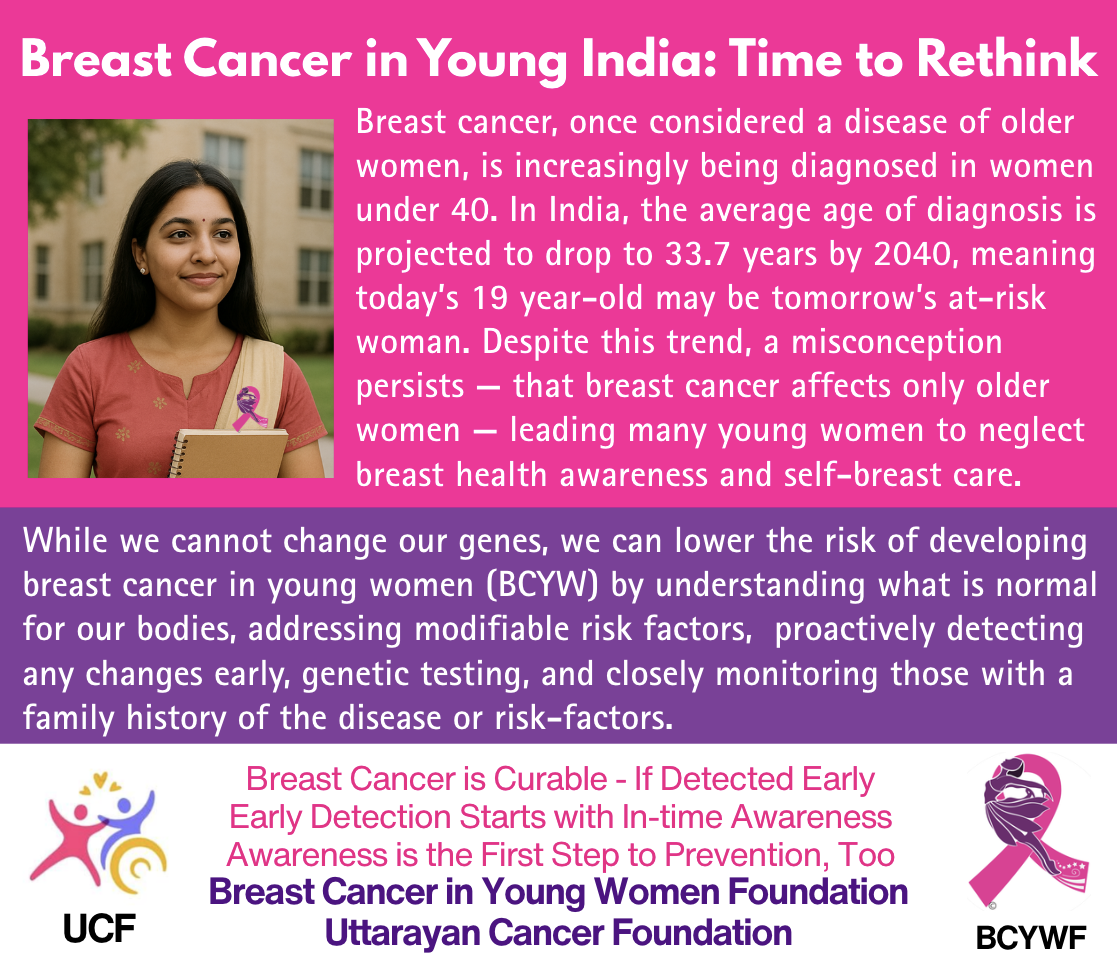
DENVER, CO, UNITED STATES, January 12, 2026 /EINPresswire.com/ -- Breast cancer, once considered a disease primarily affecting older women, is increasingly impacting women under 40 in India. This shifting trend underscores an urgent need for awareness and preventive action among younger age groups. Many young women still believe breast cancer is “an older woman’s disease,” leaving them unaware of their own vulnerabilities, especially during puberty and early adulthood when modifiable risk factors begin to emerge. Limited understanding of breast health, limited preventive information, and a structured program on self-breast care further compound the challenge.YOUTH COUNCIL FOR BREAST HEALTH (YCBH): A CAMPUS-FOCUSED SOLUTION
According to the World Health Organization, breast cancer will continue to be the leading cancer among women of all ages in India, with cases among women under 39 projected to rise in the coming decades. The projected average age of diagnosis—33.73 years by 2040—indicates that today’s 18- and 19-year-old young adults are tomorrow’s highest-risk demographic. Empowering them now can have a transformative, long-term impact on women’s health nationwide.
In response, the BCYW Foundation launched the Youth Council for Breast Health (YCBH)—its flagship global youth program—organized by local mentors and experts—to equip young women with the knowledge and tools to prevent, detect early, and reduce breast cancer risks on campuses.
YCBH chapters promote year-round, far beyond Pink October, and are driven by peer-led discussions, awareness initiatives, and self-care tools and advocacy. Each chapter serves as a sustained, student-powered engine for health promotion. In 2025, the BCYW Foundation has established about 25 chapters, of which nine are in the State of Uttarakhand, India, which also has four global ambassadors of the BCYW Foundation, including Sunil Saini, MBBS, MS; Farhanul Huda, MBBS, MS; Vartika Saxena, MBBS, MD; and Anjali Nauriyal, PhD.
CORE FEATURES OF YCBH CAMPUS CHAPTERS
• Local Mentors, Student Leads, and Ownership: Trained students supported by faculty advisors, followed by tools and resources, and a framework provided by BCYW Foundation.
• Local NGO: Wherever possible, collaboration with local non-profit organizations
• Guest Medical Mentors: Medical and nursing mentors for campuses without health departments.
• Awareness Infrastructure: Posters, wall spaces, and digital boards dedicated to breast-health resources.
• Peer-to-Peer Learning: Student-led discussions normalizing conversations about self-care.
• Regular Events: Continuous engagement throughout the year.
• Digital Updates: Biannual resource kits for chapter leads and mentors.
UTTARAKHAND: A SUSTAINABLE MODEL FOR EARLY TARGETED INTERVENTION
Uttarakhand is emerging as a pioneering state in implementing a structured, grassroots model for breast-health empowerment among young women. With its diverse educational institutions spread across urban and rural settings, the state offers an ideal testing ground to demonstrate how early intervention on campuses can shape long-term public health outcomes. This initiative may position Uttarakhand as a model, demonstrating how targeted education and campus-level community-building can empower a generation of young women to proactively safeguard their health.
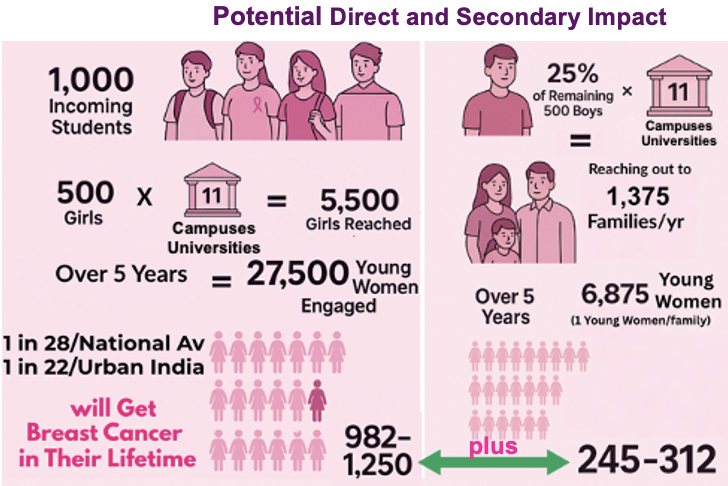
Going forward, in addition to directly working with the educational campus leadership, the BCYW Foundation has entered into a collaborative relationship with the Uttarayan Cancer Foundation (UCF) for establishing volunteer chapters and thus, help create a future free of breast cancer across educational campuses in the State of Uttarakhand by establishing Breast Health Awareness Chapters. In partnership with UCF and BCYWF, the BCYW Foundation plans to create YCBH Volunteer Chapters at about 10-12 major universities in Uttarakhand. If we reach about 500 girls at each university annually, this empowerment initiative could benefit about 5,500 young women each year and around 27,500 over five years at 11 major universities with large annual enrollments. Data show that 1 in 28 women in India and 1 in 22 in urban areas face a lifetime risk of breast cancer. Because half of the students are boys, the UCF/BCYWF Foundations also expect a secondary effect on boys’ families and to reach out to at least 25% of boys and, in turn, young women in their families. Therefore, targeted awareness programs during the college years could prevent or enable early detection in approximately 982 to 1,250 women, potentially saving lives.
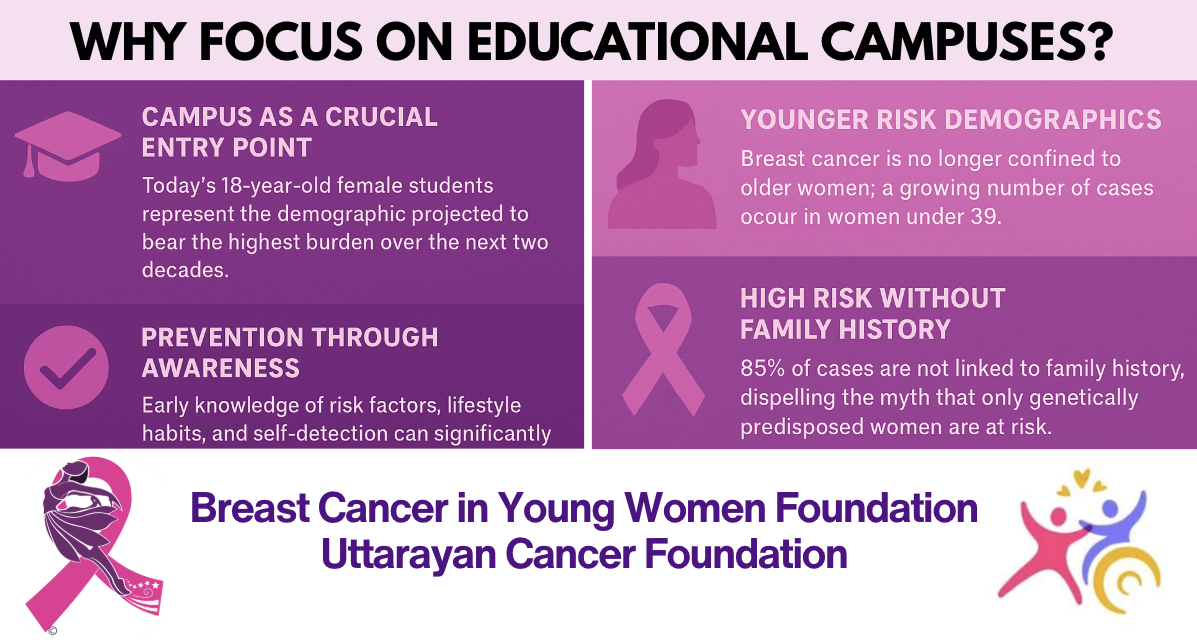
WHY EDUCATIONAL CAMPUSES ARE CRITICAL
• Younger Risk Demographics: A growing number of breast cancer cases occur in women under 39.
• High Risk Without Family History: Nearly 85% of cases arise without any family history, dispelling the myth of genetic exclusivity.
• Value of Genetics Awareness: While genes can’t be modified, understanding hereditary risks enables closer monitoring and early detection.
• Campus as Entry Point: Today’s 18-year-olds represent the demographic most likely to bear the burden of breast cancer over the next two decades.
• Prevention Through Awareness: Early education on risk factors, lifestyle habits, and self-detection significantly improves survival outcomes.
EXAMPLES OF POTENTIAL VALUES
• Formal chapters embed breast-health awareness into campus culture.
• Moves beyond “Pink October” to year-round engagement.
• Empowers young women to take ownership of their health.
• Encourages adoption of self-care practices and early detection behaviors.
• Builds community-level leadership through student-driven advocacy.
• Students trained on campuses carry knowledge home, spreading awareness among families and communities and helping normalize conversations about breast health.
• Higher rates of early detection reduce late-stage diagnoses.
ABOUT
The BCYW Foundation is a global organization with a presence in 30 countries dedicated to advancing research, raising awareness, and providing support to young women affected by breast cancer. Through partnerships and advocacy, the foundation is committed to creating a future where no young woman feels overlooked in her fight against this disease. More recently, BCYW Foundation launched The Youth Council for Breast Health (YCBH), a global initiative to transform the future of young women’s health at campuses by raising awareness about breast health, breast cancer symptoms, and risk factors.
The BCYW Foundation relies on individual contributions and sponsors to raise the funds necessary to support its mission. Donate to BCYW Foundation: Every contribution – big or small – helps the BCYW Foundation fulfill its mission to save the lives of young women from breast cancer in the years to come. Thank you for your generosity.
Rakesh Kumar, Ph.D., Founder and CEO
Breast Cancer in Young Women Foundation
bcywf@breastcancerinyoungwomen.org
Visit us on social media:
LinkedIn
Instagram
Facebook
YouTube
X
Legal Disclaimer:
EIN Presswire provides this news content "as is" without warranty of any kind. We do not accept any responsibility or liability for the accuracy, content, images, videos, licenses, completeness, legality, or reliability of the information contained in this article. If you have any complaints or copyright issues related to this article, kindly contact the author above.
